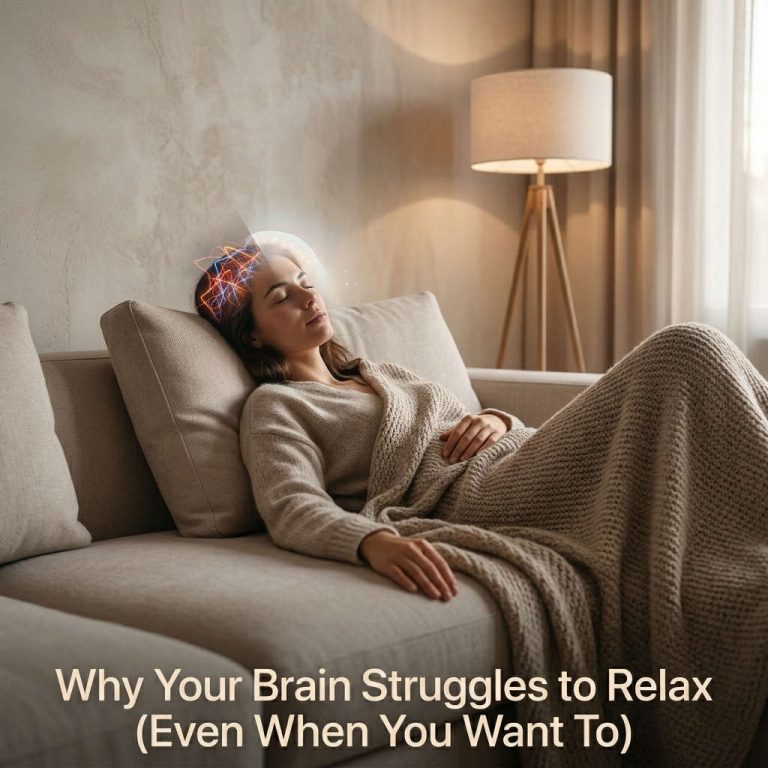
Have you ever noticed that relaxing sounds easy in theory but surprisingly difficult in practice?
You finally have free time. You sit down, hoping to unwind — yet your thoughts keep moving. Your body feels restless, your attention jumps from one idea to another, and calm never fully arrives.
This experience is extremely common today, and it doesn’t mean you’re doing relaxation “wrong.” In many cases, the brain has simply learned to stay alert for too long.
Understanding why this happens can make relaxation feel achievable again.
Relaxation Is Not a Switch — It’s a Process
Many people assume relaxation works like turning off a light. In reality, the brain transitions gradually between states.
Your nervous system operates along two main modes:
- Alert mode — focused on action and problem-solving
- Recovery mode — focused on repair, digestion, and emotional balance
Modern lifestyles keep the brain heavily trained in alert mode. Even when external demands stop, internal activity continues because the nervous system hasn’t yet received enough signals of safety.
Relaxation requires a shift — not a decision.
The Brain Learns Stress Through Repetition
The brain constantly adapts based on repeated experiences. This ability, known as neuroplasticity, helps us learn skills but also reinforces stress patterns.
If your daily routine includes:
- constant notifications
- multitasking
- time pressure
- information overload
your brain begins to expect continuous stimulation.
Over time, stillness can feel unfamiliar — even uncomfortable.
This is why some people feel more restless during quiet moments than during busy ones.
Why Thinking Harder Doesn’t Calm the Mind
When relaxation fails, many people try to force calmness:
- “Stop thinking.”
- “Just relax.”
- “Clear your mind.”
Ironically, effort activates the same brain regions responsible for planning and control — the opposite of relaxation.
True relaxation happens when the brain reduces effort, allowing slower neural rhythms to emerge naturally.
That’s why passive calming activities often work better than intense concentration techniques for beginners.
Your Body Often Decides Before Your Mind Does
Relaxation begins physically before it becomes mental.
Your brain continuously monitors signals from the body such as:
- breathing speed
- muscle tension
- heart rate
- sensory input
If the body remains tense, the brain assumes a threat may still exist.
Small physical adjustments can therefore influence mental calm:
- slower breathing
- softer lighting
- reduced noise
- comfortable posture
These cues quietly tell the nervous system that it’s safe to shift into recovery mode.
The Hidden Role of Modern Stimulation
One of the biggest barriers to relaxation today is constant stimulation.
Even enjoyable activities — scrolling, streaming, or multitasking entertainment — keep attention systems active. The brain never fully disengages.
This explains why people often feel:
- tired but mentally awake
- exhausted yet unable to sleep
- restless during downtime
Your brain isn’t resisting relaxation; it simply hasn’t practiced it enough recently.
For a deeper look at how constant pressure affects thinking patterns, you can explore our article on why mental clarity feels harder than ever.
How the Brain Relearns Calm
The encouraging news is that relaxation is trainable.
The brain gradually relearns calm when it experiences repeated moments of safety and low stimulation.
Helpful approaches include:
- predictable daily routines
- quiet transition periods before sleep
- gentle sensory environments
- calming sound experiences
- consistent wind-down rituals
Small repetitions matter more than dramatic changes.
Over time, the brain begins to associate certain environments and sounds with relaxation automatically.
Helpful Tools That May Support Your Relaxation Routine
Some people find it easier to relax when their environment consistently signals calmness to the brain. Simple wellness tools can help create these cues.
- A white noise or sound machine can provide steady background sound that reduces sudden distractions and supports relaxation.
- A guided mindfulness journal may help release lingering thoughts before bedtime, allowing the mind to slow naturally.
❓ Frequently Asked Questions
– Why can’t I relax even when I have free time?
Your brain may still be operating in alert mode due to prolonged stress or stimulation. Relaxation requires gradual nervous system adjustment rather than immediate mental control.
– Is it normal to feel anxious during quiet moments?
Yes. When the brain becomes used to constant activity, silence can initially feel unfamiliar. With repeated calm experiences, this reaction usually decreases.
– How long does it take to train the brain to relax?
Many people notice small improvements within days or weeks of consistent calming habits, though lasting changes develop gradually through repetition.
– Can sound really help the brain relax?
Certain sound patterns can encourage slower brain activity associated with rest and emotional regulation, which may help some individuals transition into relaxation more easily.
A Gentle Next Step
Alongside daily habits and environmental changes, some people explore guided audio experiences designed to help the brain move toward calmer mental states without requiring intense effort.
One example is The Brain Song, a sound-based program created to support relaxation and emotional balance through structured auditory patterns.
You can learn more about it and decide whether it fits your personal approach to mental wellness.